Israelites
Common SenseThe Israelites are central to Thomas Paine’s scriptural case against monarchy. In his reading of their history, they first lived without kings under a form of government administered by judges and tribal elders, and their two later demands for a king expressed a rejection of divine rule in favor of imitation of other nations. Their story culminates not in royal legitimacy but in warning: a people who insist on monarchy are shown what it will cost them, and their example becomes an argument for governments yet to be formed to reject hereditary rule.
Government Before the Kings
Paine places the Israelites within a long interval in which, according to the chronology of scripture, kings were absent. He describes their earlier political order as a kind of republic, ordinarily administered by a judge and the elders of the tribes, with divine intervention reserved for extraordinary cases. In his account, they had no king, and acknowledging anyone by that title was treated as sinful because the Lord of Hosts alone held rightful sovereignty. The contrast is also part of his broader argument that the early absence of kings meant an absence of wars, while royal pride brought disorder among peoples.
For Paine, the Israelites’ eventual turn toward kingship was not a natural development or a neutral change of political form. Their demand came after roughly three thousand years from the creation as recounted in the Mosaic account, and he calls it a national delusion. He interprets the reverence paid to kings as an affront to divine honor: elevating a human ruler above others, in his view, has neither a basis in natural equality nor in scripture. The Israelites’ history therefore serves as evidence in a political-theological argument, rather than as an impartial account of their institutions.
Gideon’s Refusal and the First Invitation
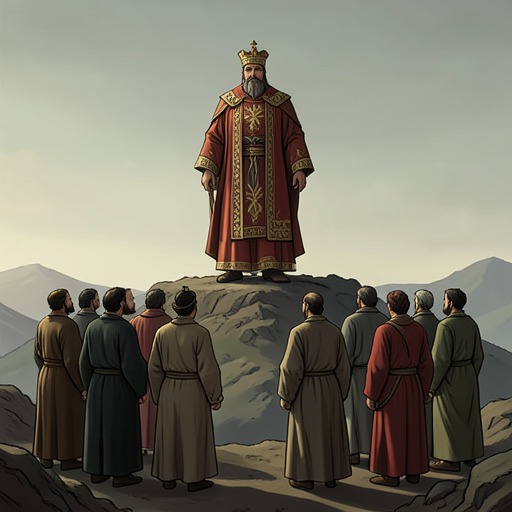
The first decisive episode begins when the Israelites are oppressed by the Midianites. Gideon leads a small army against them, and victory follows through divine intervention. The people attribute their success to Gideon’s military leadership and invite him to rule over them, extending the offer beyond his own lifetime by proposing that his son and grandson also reign. The hereditary terms make the invitation especially significant for Paine’s argument: the people are not merely asking for a leader, but proposing a continuing royal family.
Gideon refuses. His answer is that neither he nor his son will rule over them, because the Lord will rule over them. Paine emphasizes that Gideon’s response is not simply a modest decline of personal honor. He treats it as a denial that the people have the right to confer sovereignty in this way, and as an explicit charge that they are turning away from their proper ruler in heaven. In this telling, the Israelites’ invitation and Gideon’s refusal establish a clear choice between human kingship and divine sovereignty.
The Request to Samuel
About 130 years later, the Israelites repeat the demand. This time they approach the prophet Samuel, pointing to the misconduct of his two sons, who had been entrusted with secular responsibilities. They call attention to Samuel’s age and his sons’ failure to follow his ways, then ask for a king to judge them like other nations. Paine distinguishes their stated complaint from what he regards as their deeper motive: they want to be like the surrounding nations, a desire he considers particularly misguided because Israel’s distinction should have been to remain unlike them.
Samuel is displeased and prays to the Lord. The answer, as Paine presents it, explains that the people have rejected not Samuel but God’s rule over them. Their demand repeats a pattern of forsaking God and serving other gods, and Samuel is instructed to warn them about the general manner of kings. This exchange makes the Israelites’ request more than a practical response to the failure of Samuel’s sons: within Paine’s interpretation, it is a rejection of divine sovereignty and a turn toward a political institution associated with idolatry.
Samuel’s Warning and the People’s Choice
Samuel’s warning spells out the costs of kingship in practical terms. The king will take the people’s sons for his chariots, horsemen, and military organization; some will run before the chariots. He will assign others to cultivate his ground, reap his harvest, and make instruments of war. Their daughters, too, will be taken for service as confectioners, cooks, and bakers. The king will take the best fields and olive yards for his servants, claim a tenth of seed and vineyards for officers and servants, and take servants, young men, asses, and sheep for his work. Paine reads this forecast as a catalogue of royal extraction, expense, favoritism, and oppression.
The warning ends with a consequential prediction: the people will cry out because of the king they chose, and the Lord will not hear them in that day. The Israelites refuse to obey Samuel. They insist that they want a king to judge them, go before them, and fight their battles, so that they may be like all the nations. Samuel continues to reason with them and confronts their ingratitude, but they remain set on the request. The narrative thus makes the people’s choice consequential: the burdens Samuel describes are not imposed without warning, but follow a demand made against counsel.
Thunder, Repentance, and Paine’s Political Use of the Story
Samuel calls on the Lord to send thunder and rain during the wheat harvest, a sign Paine describes as punishment. The storm comes that day, and the people greatly fear the Lord and Samuel. They ask Samuel to pray that they will not die, confessing that they have added this evil to their sins by asking for a king. Their fear and confession mark the immediate outcome of the episode, although Paine does not present them as undoing the political choice.
Paine treats these passages as direct scriptural evidence against monarchy, not as ambiguous materials that can be reconciled with royal government. He argues that monarchical societies have glossed over anti-monarchical parts of scripture, while countries still forming governments should attend to them. His interpretation also limits what can be claimed for later kings: the commendation of David, he says, praises him as a man after God’s own heart, not officially as a king. The Israelites’ story therefore remains a warning even when individual rulers receive praise.
The same warning informs Paine’s discussion of political authority more broadly. He presents the Israelites as an example of a people who chose kingship after being warned, and uses their history to challenge the claim that monarchy has divine sanction. Elsewhere he argues that governments must protect people of every conscientious religious profession, while having no further business with religion; he also advocates a solemn continental charter to bind the whole community to uphold each part’s rights in religion, personal freedom, and property. Read beside those proposals, his account of the Israelites contrasts authority grounded in a people’s mutual obligations with kingship imposed through a claim of sacred or hereditary privilege. Their repeated demand for a king becomes, in his political argument, a lasting caution about surrendering collective authority.